Technical drawings

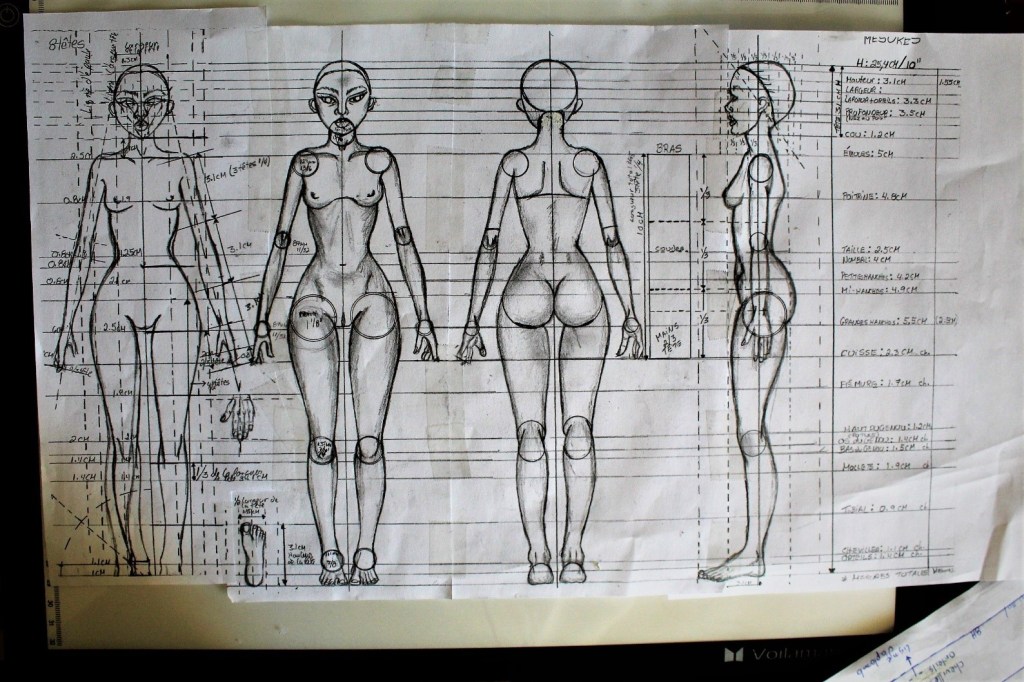
Good morning, everyone! In my last post, I talked about the next step of AMG DOLL. This next step is the creation of a doll with Barbie’s doll measurements, 12 inches high (30 cm) and to get there, I have developed technical drawings that I will use for the creation of a mannequin in Styrofoam. But before I will have to trace the silhouette on Graph paper. What you will see in my next post.

Bon matin tout le monde! Dans mas dernière publication j’ai parlé de la prochaine étape de AMG DOLL. Cette prochaine étape est la création du poupée aux mensurations de Barbie, soit 12 pouces de haut (30 cm) et pour y arriver, j’ai élaboré des dessins techniques que j’utiliserai pour la création d’un mannequin en styromousse. Mais avant je devrai retracer la silhouette sur du papier quadrillé. Ce que vous verrai dans ma prochaine publication.

What’s next for AMG DOLL

Good morning, everyone! After ten years of making dolls of all kinds, many of you are wondering what will be the next step for AMG DOLL in terms of dolls? Don’t worry because this is a question, I’ve been asking myself throughout the last couple of years. I want to avoid going around in circles with my dolls. I want unique dolls that I want to make with pleasure. But, to get there, I have to produce a few for well-defined collections. To achieve this, I plan to create silicone reproduction molds. These dolls will be smaller, with the measurements of the Barbie and Blythe dolls. Stay tuned for what’s next.

Bon matin tout le monde! Après dix années à réaliser des poupées de toute sorte, plusieurs parmi vous ce questionnent qu’elle sera la suite pour AMG DOLL en matière de poupée? Ne vous inquiétez pas parce que c’est une question que je me suis posée tout au long des deux dernières années. Je veux éviter de tourner en rond avec mes poupées. Je veux des poupées uniques que je souhaite réaliser avec plaisir. Mais, pour y arriver, je dois en produire quelques-unes pour des collections bien définies. Pour y arriver, je compte créer des moules de reproduction en silicone. Ces poupées seront plus petites, soit dans les mesures des poupées Barbie et Blythe. Reste à l’écoute pour la suite

Former clothing line!

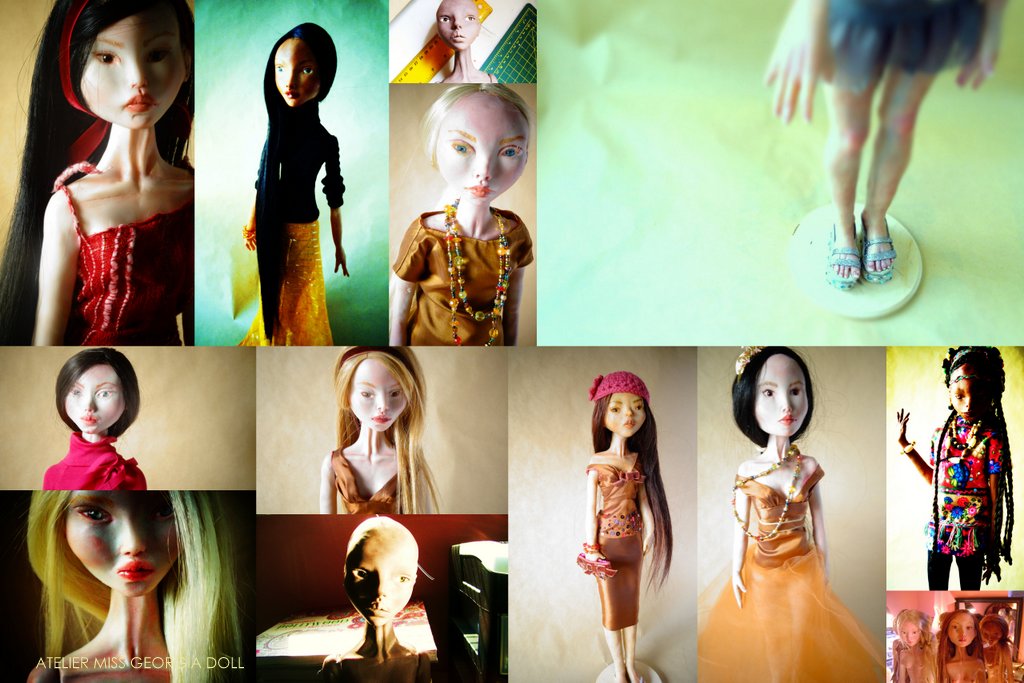
Good morning, everyone! To start this new month, I would like to thank you for all for your support and interest in my work, and would like to share with you some photos. These photos are my fashion creations under the label of Marie George Montreal. A doll clothing line that I created between 2008-2011. These clothes were made exclusively for the dolls I was collecting at the time and also sold on Ebay. Thank you all and we will see each other in the next post.

Bon matin tout le monde! J’aimerais vous remercier pour tout votre soutient que vous portez pour mon travail et pour commencer ce nouveau mois, j’aimerais partager avec vous quelques photos. Ces photos sont mes créations modes sous l’étiquette de Marie George Montréal. Une marque de vêtements de poupée que j’ai créé entre 2008-2011. Ces vêtements étaient réalisés exclusivement pour les poupées que je collectionnais à l’époque et vendait aussi sur Ebay. Merci et nous nous rêverons au prochain post.

Exploring resin BDJ DOLLS

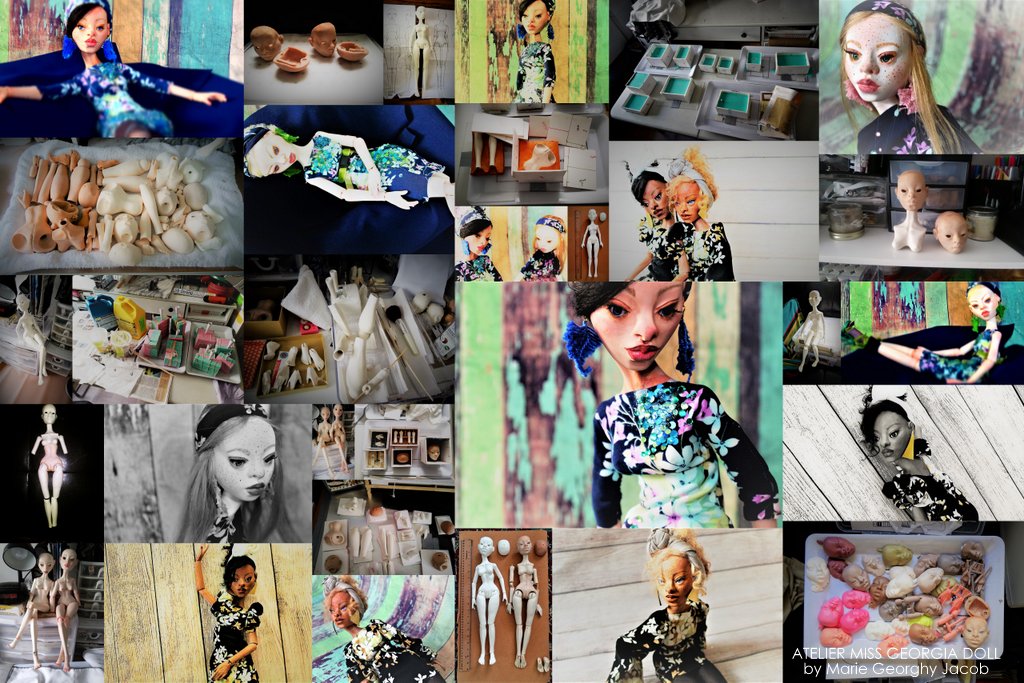
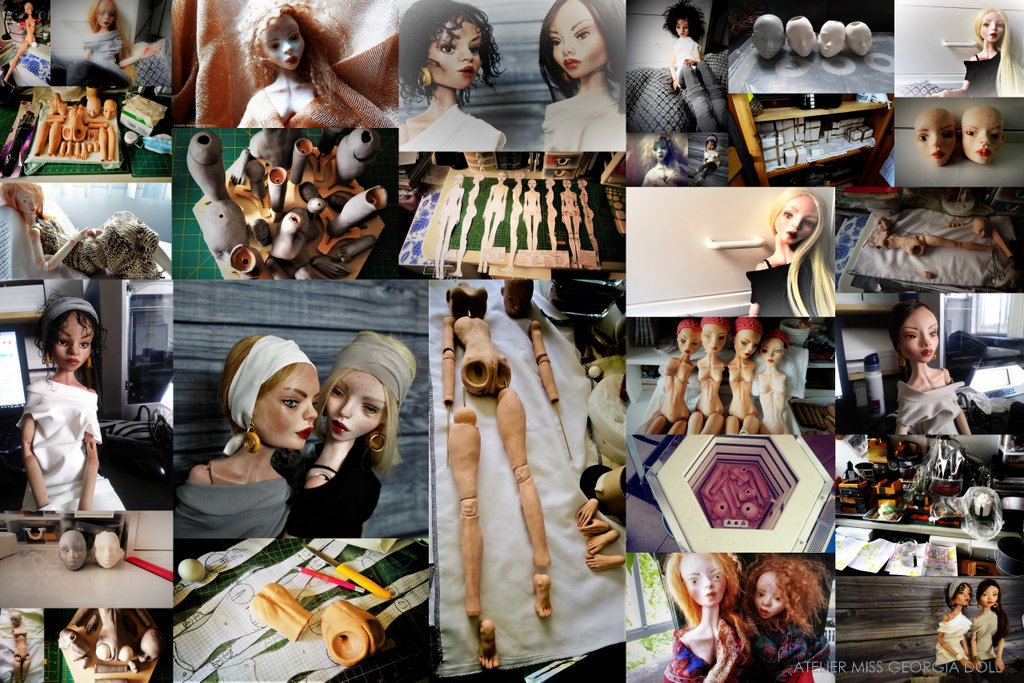
I promised myself to move on in the middle of 2020 and resin was my next challenge of choice. I was just at that stage. The steps for creating resin dolls were quite similar to those of porcelain, but less laborious. I had used the same pieces of the BDJ porcelain dolls and created others in polymer paste.

For the elaboration of silicone molds, I needed two tools: the vacuum chamber and the pressure chamber. Their functionality is different. The first, the chamber to be emptied is used to remove air bubbles in the silicone. The second, the pressure chamber, is used to reduce the air bubbles that are found in the resin. On the other hand, unlike the chamber to be emptied, this tool must work with the help of an air compressor. As you can see, expenses can be considerable.

Once the silicone molds were finished (a week of work), I still had to store them in my cabinet out of the humidity and in the shade. Then, embalmed baby powder on all molds. Next step was the casting of the polyurethane resin which hardened in three minutes! Wearing a lab coat, mask and gloves were required. In addition to the toxic smell, the resin is damaging to the skin and respiratory tract.

My first pieces made were chess! I didn’t understand anything about it. I couldn’t see what wasn’t working and something was wrong and persisting. It was then that I realized that the casting tunnels were too narrow for the circulation of the resin into liquid. The process was tricky, but fortunately my first ones were just casting tests.

Then will come, the long and laborious work of sandblasting and drilling and widening the tunnels and holes of each part of the doll. Safety was paramount! Gangs, lab coat, hair net, protective glasses and mask with filter were all a necessity! Not to mention that I needed good lighting and do it all in a well-ventilated room. The final assembly of the doll was done with elastics.

In total, it took me more than six months of work to make my first BDJ resin dolls and in total six dolls were created.

I promised myself to move on in the middle of 2020 and resin was my next challenge of choice. I was just at that stage. The steps for creating resin dolls were quite similar to those of porcelain, but less laborious. I had used the same pieces of the BDJ porcelain dolls and created others in polymer paste.

For the elaboration of silicone molds, I needed two tools: the vacuum chamber and the pressure chamber. Their functionality is different. The first, the chamber to be emptied is used to remove air bubbles in the silicone. The second, the pressure chamber, is used to reduce the air bubbles that are found in the resin. On the other hand, unlike the chamber to be emptied, this tool must work with the help of an air compressor. As you can see, expenses can be considerable.

Once the silicone molds were finished (a week of work), I still had to store them in my cabinet out of the humidity and in the shade. Then, embalmed baby powder on all molds. Next step was the casting of the polyurethane resin which hardened in three minutes! Wearing a lab coat, mask and gloves were required. In addition to the toxic smell, the resin is damaging to the skin and respiratory tract.

My first pieces made were chess! I didn’t understand anything about it. I couldn’t see what wasn’t working and something was wrong and persisting. It was then that I realized that the casting tunnels were too narrow for the circulation of the resin into liquid. The process was tricky, but fortunately my first ones were just casting tests.

Then will come, the long and laborious work of sandblasting and drilling and widening the tunnels and holes of each part of the doll. Safety was paramount! Gangs, lab coat, hair net, protective glasses and mask with filter were all a necessity! Not to mention that I needed good lighting and do it all in a well-ventilated room. The final assembly of the doll was done with elastics.

In total, it took me more than six months of work to make my first BDJ resin dolls and in total six dolls were created.

Je me suis promise de passer à autre chose vers le milieu de l’année 2020 et la résine était mon prochain défi de choix. J’étais tout simplement rendue à cette étape. Les étapes pour la création de poupées résines étaient assez similaire à celles de la porcelaine, mais moins laborieuses. J’avais utilisé les mêmes pièces des poupées BDJ porcelaine et créée d’autres en pâte de polymère.

Pour l’élaboration des moules de silicones, il me fallait deux outils: la chambre à vider et la chambre à pression. Leur fonctionnalité est différente. La première, la chambre à vider est utilisée pour enlever les bulles d’air dans le silicone. La seconde, la chambre à pression, est employée afin de diminuer les bulles d’air qui se retrouvent dans la résine. Par contre, contrairement à la chambre à vider, cet outil doit fonctionner avec l’aide d’un compresseur d’air. Comme vous le voyez les dépenses peuvent-être considérables.

Une fois les moules de silicone étaient terminés (une semaine de travail), Il me restait à les entreposer dans mon armoire hors de l’humidité et dans l’ombre. Puis, embaumés de la poudre pour bébé sur tous les moules. Prochaine étape était le coulage de la résine de polyuréthane qui durcissait en trois minutes! Le port d’un sarrau, d’un masque et de gants étaient nécessaires. Outre l’odeur toxique, la résine est dommageable pour la peau et les voies respiratoires.

Mes premières pièces réalisées étaient des échecs! Je n’y comprenais rien. Je n’arrivais pas à voir ce qui ne fonctionnait pas et quelque chose clochait et persistait. C’est alors que je réalisais que les tunnels de coulage étaient trop étroits pour la circulation de la résine en liquide. Le processus fut délicat, mais heureusement que mes premières n’étaient que des tests de coulage.

Puis viendront, le travail long et laborieux du sablage et du perçage et d’élargissement des tunnels et des trous de chaque partie de la poupée. La sécurité était primordiale! Gangs, sarrau, filet pour les cheveux, lunette de protection et masque avec filtre étaient tous une nécessité! Sans oublier qu’il me fallait un bon éclairage et réaliser le tout dans une pièce bien aérée. L’assemblage finale de la poupée se faisait avec des élastiques.

Au total, il m’a fallu plus de six mois de travail pour la réalisation de ma première poupées BDJ de résine et au total ce sont six poupées qui ont été créées.

Exploring porcelain BDJ DOLLS

In 2018, I gave myself a brand-new gift! I had bought myself a small electric oven. The decision to get this kiln was crucial: it allowed me to make several porcelain prototypes (heads, feet, tests of liquid clay colors, glaze, etc.). For months, I inquired about the different brands available on the market. But first and foremost, I took the time to make a list of what I wanted. I wanted a small electric oven that was easy to use, clean, store and within my budget. I also thought about the long term: how many times a year would I use it?

Before making any type of purchase, you must take the time to think about all these questions, get informed and ask for advice! Before firing a porcelain piece, I had to test this new electric oven. In order to stabilize the heating elements, since the first two cooking are imperative!

A major challenge awaited me: The manufacture of plaster molds. A messy job! And I who thought the painting was worse, but nothing can beat the plaster! It was pure horror! Still, despite all the precautions I had taken, I had prepared well, but I didn’t expect that! You see, making molds required space, a lot of space! But also, good lighting and good ventilation and not to mention safety which is paramount! So, wearing a mask with dust cartridges and toxic mists, was mandatory (plaster contains silica). To this had to be added the use of goggles and rubber gloves. Two months of hell watching my little studio-office enter a real mess!

You see, the creation of porcelain dolls is relatively expensive due to the different stages of manufacture: creation of prototype in polymer paste, the application of an after, the manufacture of plaster molds, etc.) To limit costs and waste of plaster, I developed a worktop that allowed me to calculate the number of grams of plaster to use versus the number of liters of water to be used for each piece of my porcelain BJD doll.

Then came the casting of porcelain and the demoulding or each of the pieces of porcelain were as fragile as an eggshell! Any false movements risked breaking the piece of porcelain before they were cleaned. At this stage, I had to remove impurities, redefine details, including ears and facial elements. I also had to “smooth” the piece of porcelain with the help of a wick tulle as an abrasive material. It should be noted that wearing a mask is vital for this work and had to be done in a well-ventilated room. A laborious and delicate process. Fortunately, I was perfectly equipped!

Subsequently, follow the different cooking (fast cooking called greenware (6 hours) and the second said biscuit (between 8 and 10 hours). Subsequently, came the application of the first layers of porcelain paint. Finally, there was the suede break between each of the pieces and the assembly of the doll with rods, metal springs, S-hooks and pivots. All metal. In total, seven BDJ porcelain dolls will be born and no more.

In short, creating porcelain BDJ doll is a long, laborious and very expensive process, so it is a luxury good.

En 2018, je me suis offerte tout nouveau cadeau! je m’étais procurée un petit four électrique. La décision de me procurer ce four était cruciale : elle me permettait d’effectuer plusieurs prototypes en porcelaine (têtes, pieds, tests de couleurs d’argile liquide, de glaçure, etc.) Durant des mois, Je me suis renseignée sur les différentes marques disponibles sur le marché. Mais avant tout, j’ai pris le temps de dresser une liste de ce que je voulais. Je voulais un petit four électrique facile à utiliser, à nettoyer, à ranger et qui respectait mon budget. J’ai aussi pensé au long terme: combien de fois par année je l’utiliserais? Avant d’effectuer tout type d’achat, il faut prendre le temps de réfléchir à toutes ces questions, s’informer et demander conseil!

Avant d’effectuer toute cuisson d’une pièce en porcelaine, il me fallait tester ce nouveau four électrique. Afin de stabiliser les éléments chauffants, puisque les deux premières cuissons sont impératives!

Un défi de taille m’attendait : La fabrication de moules en plâtre. Un travail des plus salissant! Et moi qui pensait que la peinture était pire, mais rien ne peut battre le plâtre! C’était une pure horreur! Pourtant, malgré toutes les précautions que j’avais prises, je m’étais bien préparée, mais je ne m’attendais pas à cela! Voyez-vous, la fabrication de moules demandait de l’espace, beaucoup d’espace! Mais aussi un bon éclairage et une bonne ventilation et sans parler de la sécurité qui est primordiale! Donc, le port d’un masque avec des cartouches anti-poussières et des brumes toxiques, était obligatoire (le plâtre contient du silice). A cela, il fallait ajouter l’utilisation de lunettes de protection et des gants de caoutchouc. Deux mois d’enfer à regarder mon petit atelier-bureau entrer dans un vrai désordre!

Voyez-vous, la création de poupée de porcelaine coûte relativement coûteuse dû aux différentes étapes de fabrication : création de prototype en pâte de polymère, l’application d’un après, la fabrication de moules de plâtre, etc.) Pour limiter les coûts et le gaspillage de plâtre, j’ai élaboré un plan de travail qui me permettait de calculer le nombre de gramme de plâtre à utiliser versus du nombre de litre d’eau à employer pour chaque pièce de ma poupée BJD de porcelaine.

Par la suite venait le coulage de la porcelaine et le démoulage ou chacune des pièces de porcelaine étaient aussi fragiles qu’une coquille d’œuf! Tout faux mouvements risquaient de briser la pièce de porcelaine avant leur nettoyage. A cette étape, je devais enlever les impuretés, redéfinir les détails, dont les oreilles et les éléments du visage. Je devais aussi « lisser » la pièce de porcelaine avec l’aide d’une tulle en mèche comme matière abrasive. Fait à noter, le port d’un masque est vital pour ce travail et devait être effectué dans une pièce bien aérée. Un processus laborieux et délicat. Heureusement que j’étais parfaitement outillée!

Par la suite, suivrons les différentes cuissons (cuisson rapide dite greenware (6 heures) et la seconde dite biscuit (entre 8 et 10 heures). Par la suite, venaient l’application des premières couches de peinture de porcelaine. Pour terminer, il y avait la pause de suède entre chacune des pièces et l’assemblage de la poupée avec des tiges, des ressors, des crochets en S et pivots. Tous en métal. Au total, sept poupées BDJ de porcelaine verront le jour et pas plus.

En bref, la création de poupée BDJ de porcelaine est un processus long, laborieux et très coûteux, donc c’est un bien de luxe.
Exploring big BDJ DOLLS

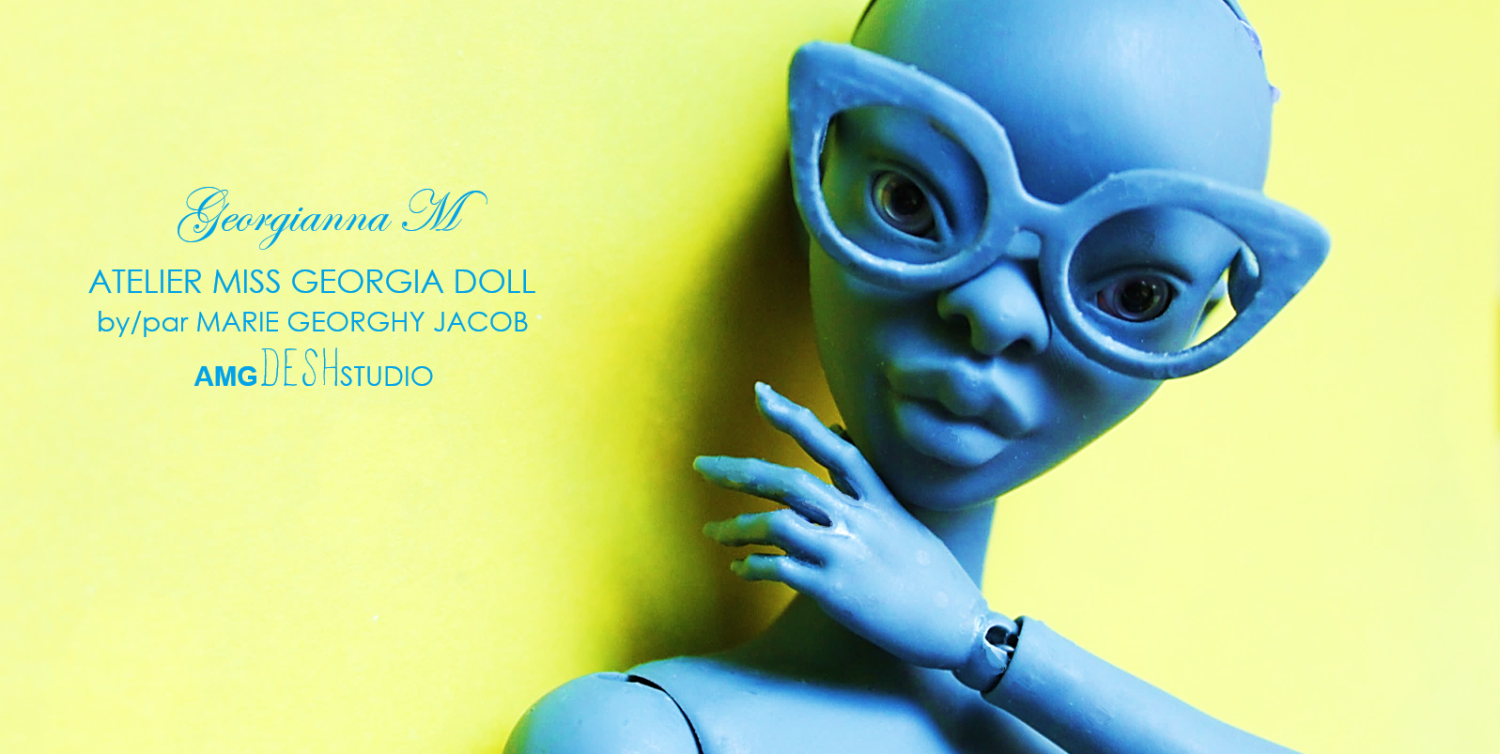
After the last six years, I had made 45 dolls and 3 of them were BJDs and each one was now archived and documented. In 2018, I focused on making a huge 60 cm high (24 inch) prototype made of polymer paste. Six months of long work.

Six months of working on it, from technical drawing, clay mixing, sandblasting and of course, sculpting! Sculpting was a challenge, especially when it came to symmetry. When I was sculpting, I had to measure, photograph and look at the doll from every angle and take notes. All this valuable information was then put on file. This process allowed me to keep the history of the doll I worked.

This prototype doll was the beginning of a whole new challenge, that of making plaster molds. These molds were used for the creation of porcelain dolls. But before I dived headfirst into this challenge, the idea of creating large dolls 56 cm high (22 inches) had come to me. With my surplus polymer paste four were made: Sudanna, Estelle, Olivia & Nora. They were all created in pure happiness.

Après six dernières années, j’avais fabriqué 45 poupées et 3 d’entre-elles étaient des BJD et chacune était maintenant archivées et documentés. En 2018, je me suis attardée dans la fabrication d’un immense prototype de 60 cm de haut (24 pouces) en pâte de polymère. Six mois de long travail.

Six mois à travailler sur elle, du dessin technique, au mélange d’argile, au sablage et bien sûr, à sculpter ! Sculpter était un défi, surtout quand il s’agit de la symétrie. Lorsque je sculptais, je devais mesurer, photographier et regarder la poupée sous chaque angle et prendre des notes. Toutes ces informations précieuses étaient par la suite mises dans des dossiers. Ce processus, me permettait de garder l’historique de la poupée qui j’ai travaillais.

Cette poupée prototype était le début d’un tout nouveau défi, celui de la fabrication de moules de plâtre. Ces moules étaient utilisés pour la création de poupées de porcelaine. Mais avant de me plonger tête première dans ce défi, l’idée de créer de grandes poupées de 56 cm de haut (22 pouces) m’était venu. Avec mes surplus de pâte de polymère quatre furent réalisées : Sudanna, Estelle, Olivia & Nora. Elles furent toutes créées dans un pur bonheur.

Exploring new techniques & improvements

In the spring of 2015, another year that had proven to be very productive, I had the idea to take pictures of all the dolls I had made. Right away, I saw the pleasure I had there. At first my photography techniques were not of a high level and not to mention the camera I used… But I made do with what little I had. Doll making can be expensive and that’s why I had kept the polymer paste for the next three years to come.

I wanted to perfect my modeling techniques to the best of my knowledge because an exciting new adventure in the world of the handmade artist doll was waiting for me: the manufacture of BDJ dolls. Fully articulated dolls. I am likely to love challenges and start new projects and the following year will be a beneficial and decisive one.

Au printemps 2015, une autre année qui s’était avérée très productive, j’ai eu l’idée de prendre en photos toutes les poupées que j’avais fabriquées. Tout de suite, j’ai vu le plaisir que j’y avais. Au début mes techniques de photographie n’étaient pas de haut niveau et sans parler de la caméra que j’utilisais… Mais, je me débrouillais avec le peu que je possédais. La fabrication de poupée peut être coûteuse et voilà pourquoi j’avais gardé la pâte de polymère pour encore les trois prochaines années avenir.

Je voulais parfaire mes techniques de modelage au mieux de mes connaissances parce qu’une nouvelle aventure excitante dans le monde de la poupée d’artiste fait main m’attendait : la fabrication de poupée BDJ. Des poupées entièrement articulées. Je suis de nature à aimer les défis et entamer des nouveaux projets et l’année suivante en sera une bénéfique et décisive.

Improving my sculpting techniques

Between the years 2013 and 2015, were productive and rewarding too. I was exploring, testing and working on my modeling techniques. I was mixing the different brands of polymer paste available on the market. I also made my own Crystal eyes and learned to work with other materials including mohair for the realization of wigs. There was no shortage of challenges! Many of my static dolls that I was making at the time were far too big to be supported by the wooden base that held them. Unfortunately, several of them saw their surface crack, due to the heaviness of the polymer paste once cooked. You have no idea that every time this unfortunate situation happened, I got angry.

But my stubbornness worked in my favor. It forced me to analyze the problem in depth and find solutions. While documenting and testing my manufacturing techniques, I could see the light at the bottom of the tunnel. My dolls were stronger, their face and body better made. How did I get there? Practice and patience! It is with these two assets that I succeeded. They allowed me to improve my techniques, increase my self-confidence and not give up.

Entre les années 2013 à 2015, ont été productives et enrichissantes aussi. J’explorais, testait et travaillait mes techniques de modelage. Je mélangeais les différentes marques de pâte de polymère disponibles sur le marché. Je fabriquais aussi mes propres yeux de Crystal et apprenait à travailler avec d’autres matières dont le mohair pour la réalisation de perruques. Les défis ne manquaient pas! Plusieurs de mes poupées statiques que je réalisais à l’époque étaient beaucoup trop grandes pour être supportées par le socle de bois qui les tenaient. Malheureusement, plusieurs parmi elles ont vu leur surface se fissurer, dût à la lourdeur de la pâte de polymère une fois cuite. Vous n’avez pas idée qu’à chaque fois que cette fâcheuse situation se produisait, je m’énervais.

Mais, mon entêtement jouait en ma faveur. Il me forçait à analyser le problème en profondeur et à trouver des solutions. En me documentant et testant mes techniques de fabrication, je voyais la lumière au fond du tunnel. Mes poupées étaient plus solides, leur visage et leur corps mieux réalisés. Comment j’y suis arrivée? La pratique et la patience! C’est avec ces deux atouts que j’ai réussi. Elles m’ont permis d’améliorer mes techniques, d’augmenter la confiance en moi et de ne pas lâcher.

Exploring polymer clay & first dolls

It all started with a personal challenge in 2012. I was already collecting at the time, in 2008, several dolls from different companies, including Ellowyne Wilde and Gene Marshall. The idea of making fashion clothes for them came naturally. Unfortunately, many of these dolls have been sculpted, modified or simply stopped productions. This situation forced me to question my future with the manufacture of doll clothes. Then, one morning in December 2011, the idea of making my very first doll out of polymer clay came to me, in the last two years earlier, I had already made a fabric doll for a contest. Especially since many doll artists made their first dolls in polymer paste. Which made me confident.

I wanted to make a doll that respected my aesthetics: the child woman with an angelic face, full of mystery and especially with an ambiguous ethnicity. My first polymer paste doll would be my birthday present for the year 2012. With the help of sculpture books, my first heads were made of children’s plasticine. I made one a day for a month, then came the realization of busts and torsos. One per week also for about six weeks. This was followed by the creation of the legs, then the delicate manufacture of the hands and feet which was a major challenge.

The other challenge I had to face was working with the different brands of polymer paste (Cernit, Prosculpt, Fimo, Super Sculpey, Kato, etc.). Each of these pastas has its own attributes and challenges and must be worked differently. For my first doll, I chose the least fragile paste and the oily one: Fimo Classique. Working on this material was quite a challenge for my hands that I no longer felt at the end. But I got there thanks to the many videos, DVDs, and artists’ books I had bought at the time.

In short, six months have passed and my very first doll, Clara was born in June 2012. I was very emotional. Despite her imperfections, she remains very special to me, since thanks to her, three other dolls are born in 2012: Danielle, Ally and Nezha. Each was made in different brands of polymer pastes, since in my early days my goal was to test each of the brands available on the market.

Tout a commencé par un défi personnel en 2012. Je collectionnais déjà à l’époque, soit en 2008, plusieurs poupées de différentes compagnies, dont Ellowyne Wilde et Gene Marshall. L’idée de réaliser des vêtements de mode pour elles, s’était faite naturellement. Malheureusement, plusieurs de ces poupées ont été resculptés, modifiés ou tout simplement les productions arrêtées. Cette situation m’a obligé à me questionner sur mon avenir avec la fabrication de vêtements de poupées. Puis, un matin au décembre 2011, l’idée de réaliser ma toute première poupée en pâte de polymère m’est venue, puisque deux ans plus tôt, j’avais déjà réalisé une poupée en tissu pour un concours. D’autant plus que nombreux artistes de poupées réalisaient leurs premières poupées dans de la pâte de polymère. Ce qui m’a rendu confiante.

Je voulais réaliser une poupée qui respectait mon esthétisme : la femme enfant au visage angélique, plein de mystère et surtout avec une ethnicité ambigüe. Ma première poupée en pâte de polymère serait mon cadeau d’anniversaire pour l’année 2012. Avec l’aide de livres de sculptures, mes premières têtes étaient fabriquées dans de la plasticine pour enfant. J’en réalisais une par jour pendant un mois, puis sont venu la réalisation des bustes et des torses. Un par semaine également pendant six semaines environ. S’en est suivi la création des jambes, puis la fabrication délicate des mains et des pieds qui fut un défi de taille.

L’autre défi que j’ai dû faire face est de travailler avec les différentes marques de pâte de polymère (Cernit, Prosculpt, Fimo, Super Sculpey, Kato, etc.). Chacune de ces pâtes possèdent leurs propres attributs et défis et se doivent être travaillé différemment. Pour ma première poupée, j’avais choisi la pâte la moins fragile et l’huileuse : Fimo Classique. Travailler cette matière fut tout un défi pour mes mains que je ne sentais plus à la fin. Mais j’y suis arrivée grâce aux nombreuses vidéos, DVD, et livres d’artistes que je m’étais procurée à l’époque. Bref, six mois se sont écoulés et ma toute première poupée, Clara voit le jour au mois de juin 2012. J’en fût très émotive. Malgré ses imperfections, elle reste à mes yeux très spéciale, puisque grâce à elle, trois autres poupées voient le jour en 2012 : Danielle, Ally et Nezha. Chacune fut réalisées dans différentes marques de pâtes de polymère, puisqu’à mes débuts mon but était de tester chacune des marques disponibles sur le marché.

Rag Doll…

My journey through the world of the doll is special. In 2001, I got married and was looking for a wedding dress… and what is the first step to finding the dress of your dreams? Well, it’s through wedding magazines. To make a long story short, from the moment I got several magazines on the preparations for a wedding, a doll review had piqued my curiosity. That magazine was the Barbie Bazaar. A magazine that allowed me to understand the fabulous world of Barbie doll collectors. A fascinating, exciting and serious universe.

A few years later, another magazine had just appeared: Haute Doll magazine. Thanks to Haute Doll my vision of fashion was enlarged and for the best! I finally saw it as another way to convey fashion with the doll.

Although in the past, the doll was and still is, the bearer of fashion messages, it was not until the middle of the 18th century that it was really at the coronation of King Louis XV in France with the two Pandora dolls. These dolls acted as models to promote the latest French fashion trends.

The very first doll I made was not one made of polymer paste, but one of fabric. It was created for a good cause, that of offering a “friend” to all children coming from families where domestic violence is omnipresent. The organization that organized this contest provided us with only the basic pattern of the doll with fairly strict manufacturing rules, such as the fabrics to be used. For the rest, we were free to do what we liked.

I admit for a first effort, I was more than delighted with the final result, although I did not win any of the three prizes offered. The experience was enriching and especially for a good cause. In the near future, I look forward to remanufacturing again.

Mon parcourt dans le monde de la poupée est particulier. En 2001, je me suis mariée et j’étais à la recherche d’une robe de robe mariée…et quelle est la première étape pour trouver la robe de ses rêves? Et bien, c’est par les revues spécialisées dans le mariage. Pour faire une histoire courte, du moment où je me suis procurée plusieurs revues sur les préparatifs d’un mariage, une revue de poupée avait piqué ma curiosité. Ce magazine était le Barbie Bazaar. Un magazine qui m’a permis de comprendre le fabuleux monde des collectionneurs des poupées Barbie. Un univers fascinant, excitant et sérieux. 

Quelques années après, un autre magazine venait de faire son apparition : le magazine Haute Doll. Grace à Haute Doll ma vision de la mode c’était agrandit et pour le mieux! J’y voyais enfin une autre façon de véhiculer la mode avec la poupée.

Bien que dans le passé, la poupée était et les toujours, porteuse des message mode, ce n’est pas avant la moitié du 18e siècle qu’elle le fut réellement au couronnement du roi Louis XV en France avec les deux poupées Pandore. Ces poupées agissaient à titre de mannequin afin de promouvoir les dernières tendances modes françaises.

La toute première poupée que j’ai réalisée ne fut pas une en pâte de polymère, mais une en tissu. Elle fut créée pour une bonne cause, celle d’offrir un ‘’ami’’ à tous les enfants venant de familles ou la violence conjugale est omni présente. L’organisme qui organisait ce concours nous fournissait que le patron de base de la poupée avec des règles de fabrication assez stricts, comme les tissus à utiliser. Pour le reste, nous étions libres de faire ce qui nous plaisait.

J’avoue pour un premier effort, j’en fut plus que ravie du résultat final, malgré que je n’aie pas gagné aucun des trois prix offerts. L’expérience était enrichissante et spécialement pour une bonne cause. Dans un futur rapproché, je compte bien de me remettre à refabriquer.