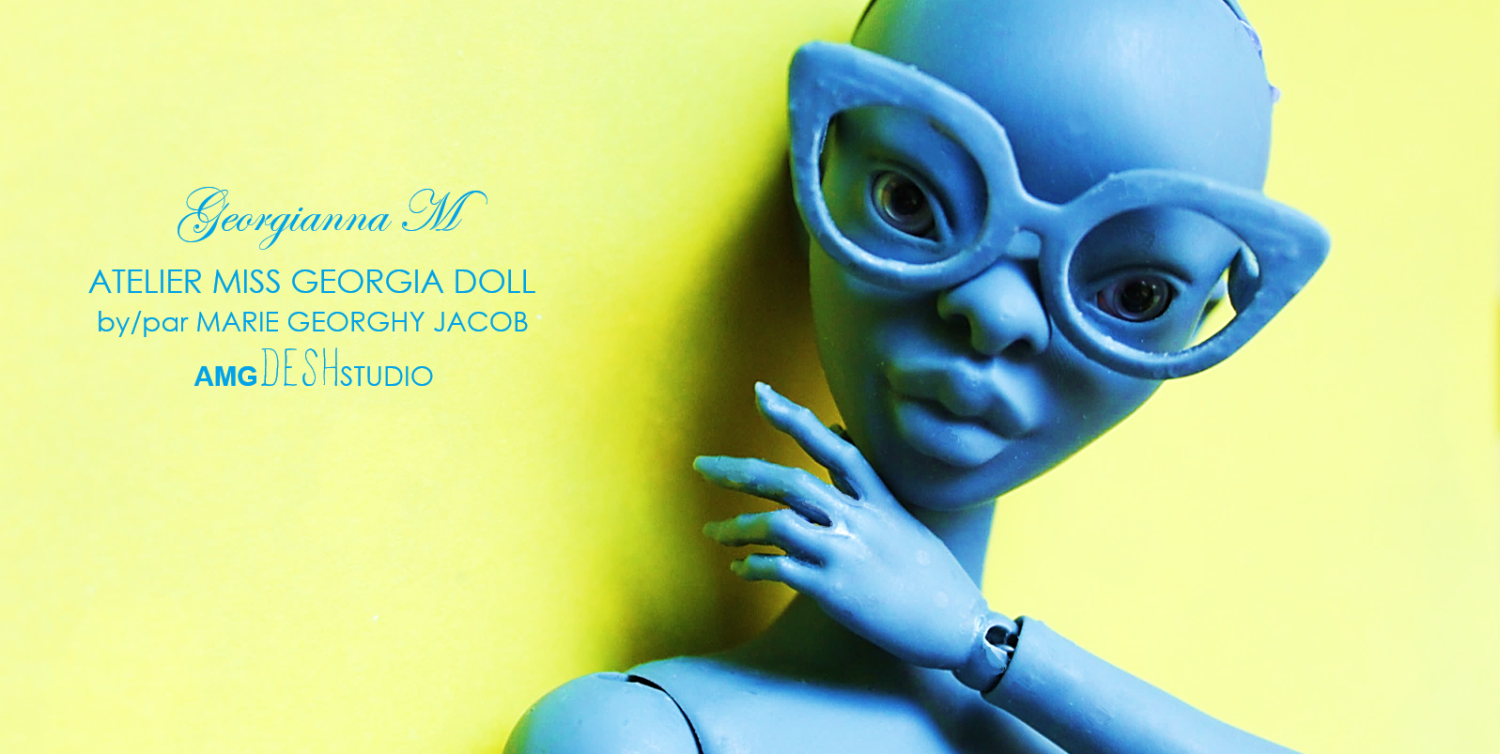


To begin with, after nearly five years of making figurative dolls, I moved on to another level: that of creating fully articulated dolls, the BDJ dolls. It was time for me to increase my level of difficulty in my book and to push my techniques and learn more.
To get there, I had the idea to get the two fantastic books by the Japanese artist Ryo Yoshida. His first book explains and illustrates how to make an articulated doll (BJD aka Ball jointed Doll) modeled with paper pulp. The second work is the continuation of the first, but with a greater dose of difficulties, including the manufacture of plaster molds. It should be noted that it is desirable, and logically, to follow the first work before accessing the second. Although both of Ryo Yoshida’s books are written in Japanese, the beautiful images speak for themselves: the entire making of the doll is illustrated step by step.
However, I planned to make my very first doll articulated in polymer paste with the help of the DVDs of the American artist Apryl Jensen (http://www.makingfairies.com/). An expert on the subject. DVDs are so well explained with simplicity. It’s been a while since I’ve been so excited for a project and experiment with some personal techniques, including using plastic straws to make the frame.
Each part or piece of the BDJ doll was composed of a custom-cut straw. Subsequently, each cut straw was wrapped in a layer of polymer paste (Sculpey Ultra Light). This light and strong paste is often used for the creation of unique artist jewelry. I was conquered with this paste. It is so easy to shape and even after cooking, it sculpts wonderfully.
On the other hand, the advantage of this polymer paste, is that once it is cooked, it is just as light as a sheet of paper. From what I had read, this asset was necessary for the BJD doll, made of polymer paste, to remain standing. The heavier the parts, the more the balance was upset. And that’s what kept the BJD doll, made of polymer paste, from keeping fluid poses or standing.
Pour débuter, après près de cinq années à réaliser des poupées figuratives, je passais à un autre niveau : celui de créer des poupées entièrement articulées, les poupées BDJ. Il était temps pour moi d’augmenter mon niveau de difficultés dans mon ouvrage et de pousser à fond mes techniques et d’en apprendre d’autres.
Pour y arriver, j’ai eu l’idée de me procurer les deux ouvrages fantastiques de l’artiste japonais Ryo Yoshida. Son premier ouvrage explique et illustre comment fabriquer une poupée articulée (BJD aka Ball jointed Doll) modelée avec de la pâte à papier. Le second ouvrage est la suite du premier, mais avec une plus grande dose de difficultés, dont la fabrication de moules en plâtre. Fait à noter, qu’il est souhaitable, et de façon logique, de suivre le premier ouvrage avant d’accéder au second. Bien que les deux livres de Ryo Yoshida soient écrit en japonais, les belles images parlent d’elles-mêmes : toute la fabrication de la poupée est illustrée étape par étape.
Toutefois, je comptais réaliser ma toute première poupée articulée dans de la pâte de polymère avec l’aide des DVD de l’artiste américaine Apryl Jensen (http://www.makingfairies.com/). Une experte sur le sujet. Les DVD sont si bien expliqués avec simplicité. Cela faisait un bon moment que je n’avais pas été tout aussi excitée pour un projet et expérimenter quelques techniques personnelles, dont l’utilisation de pailles de plastique pour réaliser l’ossature.
Chaque partie ou pièce de la poupée BDJ était composée d’une paille taillée sur mesure. Par la suite, chaque paille taillée était enveloppée dans une couche de pâte de polymère (Sculpey Ultra Light). Cette pâte légère et solide est souvent utilisée pour la création de bijoux uniques d’artiste. J’ai été conquise avec cette pâte. Elle est si facile à modeler et même après la cuisson, elle se sculpte à merveille.
D’autre part, l’avantage de cette pâte de polymère, est qu’une fois qu’elle est cuite, elle est tout aussi légère qu’une feuille de papier. Selon ce que j’avais lu, cet atout était nécessaire pour que la poupée BJD, en pâte de polymère, reste debout. Plus les pièces étaient lourdes, plus l’équilibre était contrarié. Et c’est ce qui empêchait la poupée BJD, en pâte de polymère, de garder des poses fluides ou de rester debout.
 ATELIER MISS GEORGIA DOLL
You must be logged in to post a comment.